






















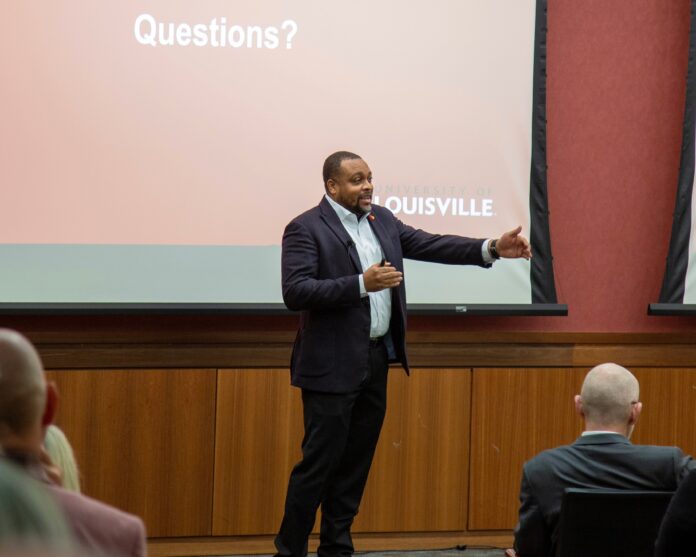
Human Resources took center stage at the Oct. 19 President and Provost Town Hall in Chao Auditorium. Darrell Clark, vice president of Human Resources, outlined new performance evaluations, merit pay and career ladders for staff, then answered questions on pay and benefits.
Performance evaluations and merit pay
Eighty-seven percent of staff received completed performance evaluations in 2025, Clark said. The real figure may be higher because not all staff are eligible for an evaluation. HR also acknowledged problems getting second-line supervisor signatures and uploading final documents to OnBase.
A Workday pilot for performance evaluations covering over 200 staff in five units (Delphi Center for Teaching and Learning, Informational Technology Services, Human Resources, Raymond A. Kent School of Social Work and Family Science and School of Public Health and Information Sciences ) reached 100% completion. A second pilot in Athletics, the only unit on a fiscal-year review cycle, also hit 100%. Workday evaluations launch campus-wide in December 2026, though provisional reviews are not included.
Along with the move to Workday a new five-point rating scale is proposed, starting with the 2026 reviews:
- 5 – Exceptional
- 4 – Highly Effective
- 3 – Effective
- 2 – Needs Improvement
- 1 – Unacceptable
Under this system, a rating of 3, effective, means an employee is doing the job they were hired to do and meeting the standards for their role. Ratings of 4 and 5 recognize work that goes beyond what the position normally requires.
As the evaluations change, HR presented two possible options for splitting a future raise pool, using a 2.5% increase as an example:
- Option 1: A 1% general wage increase for all employees, with the remaining 1.5% awarded as merit pay.
- Option 2: An even split, with 1.25% as a general wage increase and 1.25% as merit pay.
Once an option is chosen, HR will develop and communicate the framework. Merit pay is tentatively set to start in spring 2027.
“It takes time to socialize and build a culture of that,” Clark said. “Time is on [our] side here, and to have that shift in culture, it will take time for people to actually settle into it and make sure it’s in play.”
Career ladders
Career ladders, anticipated to roll out in fiscal year 2028, will give employees a path to advance, either up or across, as they build skills and take on higher-level work, if budgets allow. Levels are based on a university-wide leveling guide, which will be posted on the HR website along with current levels.
“Everyone can be eligible, but it takes a lot of other things. It’s not an automatic promotion once it starts,” Clark said.
Reclassifications will become less common but will still be possible when a job has significantly changed.
Questions on pay and benefits
Clark then answered questions from audience members on compensation and benefits.
- Funding raises in lean years: In years when the university can’t fund increases, Clark said the merit model still holds up, and units will be able to use it in the next year they are able to provide increases. “The model is still structurally sound, even if in those lean years you may not have as much flexibility, financially speaking,” he said.
- Why the 2.5% increase was a percentage: A flat amount might help some entry-level employees, but a percentage benefits more employees across the board, leaders said.
- Family leave: Various campus groups have proposed expanding family benefits, such as extending bereavement leave to pregnancy loss. Clark said the proposals were presented in early fall to the Human Resources Advisory Committee (HRAC) and are under review.
- Student and staff wages: Starting hourly rates are close but not identical. Students start at $15 and staff at $15.76. Clark said HR investigated the issue this year and found that some units pay students well above the starting rate. Efforts to reduce compression will look into related issues.
- Raises for advanced degrees: Asked whether a staff member who earns a master’s degree can receive a salary increase, Clark said there is not a blanket university-wide approach and depends on the circumstances and unit’s discretion.
- Self-insured health plan: Self-insurance gives UofL control over plan design and vendors. Pooling with other state institutions would require every participating school to agree on vendors and terms. Smaller and larger schools differ in what they can and can’t do, Clark said, and there are trade-offs either way. “It provides a greater negotiation pool; it doesn’t guarantee the rates,” he said. “There are other factors outside of claims.” UofL’s prescription coverage is already pooled through the Kentucky Rx Coalition.
Workplace conduct
- Cyberbullying and harassment: The Title IX Employee Sexual Misconduct Policy covers online stalking and cyber-harassment. Report to the Title IX Office at 502-852-1198 or titleix@louisville.edu, or the confidential compliance hotline at 1-877-852-1167.
- Retaliation: President Gerry Bradley said reporting mechanisms are in place, and reports are not handled within the employee’s own unit. University policy prohibits retaliation against anyone who files a grievance, serves as a witness or advises another employee.
- Bullying: Proposed language for a bullying statement, called for in the Climate, Culture and Well-Being report, is coming soon.
President and provost Q&A
Bradley and Provost Katie Cardarelli then took questions in-person and online, on topics ranging from pay equity and leadership accountability to artificial intelligence.
- Pay equity. Cardarelli said faculty salary equity is reviewed periodically through unit-level analyses as part of shared governance, and chairs’ requests for raises are reviewed for justification. Leaders are also looking at how to fund both wage increases and compression in the new fiscal year.
- Chief Transformation Officer. Asked why the university is adding a cabinet position amid budget challenges, Bradley said, “Everyone recognizes that higher education is different than it was.” Charlie Perusse will serve as the chief transformation officer and help lead the 2026–2030 Strategic Plan initiatives, a role that exists at several universities, including the University of Cincinnati.
- Evaluating deans. Deans receive a comprehensive review in their fifth year, and the provost can call for a review at any time.
- Artificial intelligence. Cardarelli said the university isn’t expecting “any one output or outcome” from AI. Cardinal Intelligence is aimed to create mission-centered, responsible use, with a governance structure that lets faculty, staff and students move fast. “We are living through a time of great disruption,” she said. “My goal is to create the conditions, space and resources to let us flourish.”
- Arts and Sciences budget. A faculty member asked about the long-term budget for the College of Arts and Sciences and expressed concern that the humanities are not a university priority. Cardarelli acknowledged the financial pressures and the concerns many faculty and staff share, but said A&S is not alone, pointing to Penn State’s recent proposal to cut 47 undergraduate degree programs. She said units should focus on the priorities in their newly finished strategic plans, and the university is working to increase funding and coach deans. Bradley also spoke up for the humanities, saying they are where students learn critical thinking and that the university continues to advocate with state legislators for university funding.
Share feedback
Members of the UofL community can share feedback through the October 19 Town Hall Follow-Up: Forward Together form until 5 p.m. Oct. 26.
The next President and Provost Town Hall is Thursday, Nov. 19 at noon on the Health Science Campus.
See the full recording of the October event.