





















University of Louisville mechanical engineering researcher Badri Narayanan is investigating the chemical properties of new materials combinations for improved energy storage and conversion. His discoveries have the potential to play a pivotal role in advancing energy storage and conversion technology and lead to cheap, sustainable and efficient batteries for electric vehicles and the power grid.
Narayanan’s research to decode how atoms move and interact within these materials requires hundreds of computer simulations, but the work can now progress much faster thanks to a new high-performance computing (HPC) system at UofL. The system allows Narayanan’s team to develop machine learning tools that will perform these simulations much more rapidly.
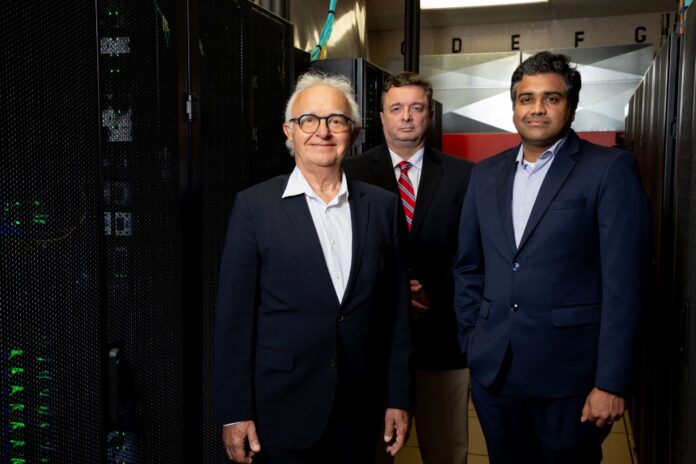
The “Zurada” HPC system, launched in late 2025, enables Narayanan and researchers across the university to conduct more advanced research in materials development, personalized medicine, AI and many other fields. The blazing fast and versatile system yields rapid solutions to a wide variety of complex computational problems and once programmed, can even perform and analyze a sequence of computer models autonomously. The researchers then assess the final results to move forward with physical experiments.
The system represents a $3.7-million computing investment that significantly enhances the university’s capabilities and will help UofL achieve its strategic research goals.
“This new HPC system represents a monumental leap forward for UofL’s research and development initiatives,” said Jon Klein, executive vice president for research and innovation. “Its processing power, combined with dedicated AI acceleration and ultra-fast networking, will empower our students, faculty and researchers to achieve breakthroughs faster and explore new frontiers previously beyond our reach.”
The materials Narayanan is testing have the potential to significantly improve the next generation of storage batteries over current lithium-ion technology. Narayanan, associate professor of mechanical engineering in the J.B. Speed School of Engineering, is modeling batteries that use iron and aluminum – inexpensive and abundant elements – and sustainable electrolytes, containing simple salts and water.
With Zurada HPC, Narayanan can run the models much more rapidly than with previous systems. He also believes the system has excellent potential to accelerate research in autonomous experimentation.
“We can develop AI models that decide what experiments to run, how to run them and how to analyze the results of those experiments,” Narayanan said. “Most of the heavy lifting is done by AI, and human scientists can come in once every so often to supervise. This platform can get results much faster.”
Narayanan said with existing approaches it would take 10 to 15 years to bring a commercial battery product such as the ones he is working on to market. Using Cardinal Intelligence, human thinking and strategy, paired with the autonomous experiments and testing capability with Zurada HPC could shorten that time to an estimated 3 to 4 years.
He also uses the HPC system in his research on metal-insulator transitions in complex oxides, which can be used for preparing the building blocks – called memristors – for brain-like computing platforms.
“We are trying to understand the atomic processes that dictate how the same material can switch from being an insulator to a metal when a voltage is applied.” Narayanan said. “Interestingly, when the direction of voltage is flipped, they turn back to insulators again. These materials hold a lot of potential in mimicking the neurons of the human brain.”
The Zurada HPC system also empowers UofL researchers to advance cutting-edge artificial intelligence research inspired by its namesake, Jacek M. Zurada. A professor of electrical and computer engineering at UofL, Zurada is known for his pioneering research in neural networks – a core technology of today’s AI – since the 1990s and has since become one of the world’s most highly cited researchers in computer engineering, according to data compiled by the global academic publishing and information analytics company Elsevier.
Adam E. Gaweda, associate professor in the School of Medicine and a former PhD student of Professor Zurada, is using Zurada HPC for AI research in personalized medicine.
“A lot of my work involves time consuming and computationally heavy AI model training, fine-tuning and simulation,” Gaweda said. “With the Zurada HPC, I will be able to run multiple such jobs in parallel, thereby accelerating the generation of new results.”
For one project, Gaweda is collaborating with Cheri Levinson in the Department of Psychological and Brain Sciences to develop tools for individualized treatment of eating disorders. He also relies on Zurada HPC in his project on AI-powered discovery of treatments and interventions to slow progression of chronic kidney disease.
Technical specifications
The various servers that comprise the Zurada HPC system have different “personalities,” each suited for specific kinds of computation and projects, according to Ritu Arora, associate vice provost of research computing. The system consists of 119 servers and features a powerful blend of blazing fast CPUs, 43 NVIDIA GPUs, very large memory servers, ultra-fast 200 gigabits-per-second networking and 5 petabytes of high-performance storage.
The system is capable of more than 1.6 petaflops of double-precision performance. “Peta” in petaflops refers to a quadrillion (1,000,000,000,000,000). “Flops” are floating-point operations per second, or the number of math problems (like 4.5 x 1.2) the system can solve every second.
In other words, Zurada HPC can perform more than 1.6 quadrillion calculations every second.
To understand the magnitude of this capability, imagine if each of the approximately eight billion people on Earth performed one calculation every second. It would take them more than 55 hours to do what this machine can do in one second. This kind of speed is necessary to solve complex problems with billions of interacting variables, such as research in drug discovery, cybersecurity, AI and high-performance materials development.
Researchers can learn more about using the system here.
About Cardinal Intelligence
Cardinal Intelligence empowers the University of Louisville to lead and learn in the age of artificial intelligence (AI) with human-centered guidance and responsibility. For generations, Cardinals have embraced technology, expanding how we learn, discover, connect and work. While AI raises important questions, our students, faculty, researchers and staff bring the curiosity and innovation needed to find answers. Through Cardinal Intelligence, we are shaping how UofL uses AI to advance our university and uncover solutions that strengthen the communities we serve.