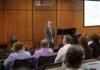













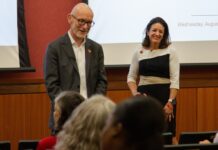








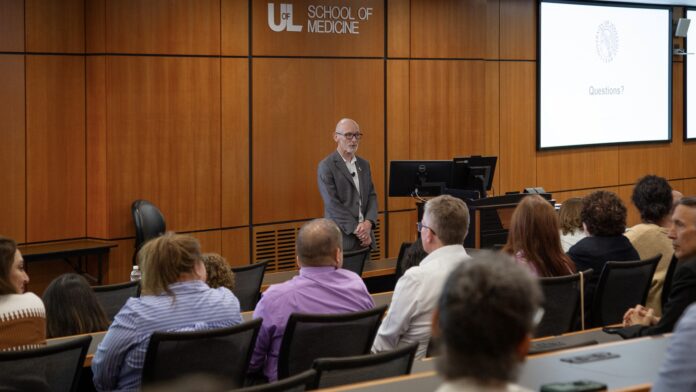
President Gerry Bradley met with faculty, staff and students Sept. 23 on the Health Sciences Center Campus, answering questions about budget planning, compensation, health coverage, athletics finances and staff morale.
Campus updates
Bradley opened with updates on items from past town halls. He covered enrollment growth, the provost’s work with units on their strategic plans and UofL’s approval to begin the Innovation Park process. He also noted recent research wins, including an $8 million C06 grant for precision medicine and an expected HRSA award of up to $30 million to equip the center.
Budget
Unmet enrollment projections and rising health care costs will shape budget decisions in the coming year. Bradley noted that UofL isn’t alone, since several rating agencies have issued negative outlooks for higher education this year.
“The north star is the strategic plan, and we are going to continue to be intentional on supporting it,” he said.
Asked what could be cut and how decisions will be made, Bradley said the budget process is transparent and built on shared governance, with input from units across campus well before final decisions. He receives monthly reports and will share more in the spring about which resources might be affected. The outcome won’t necessarily include cuts. It could mean shifting resources or improving efficiency.
Rick Graycarek, executive vice president for finance and administration and CFO, explained how the budget is developed. Input comes throughout the year from Faculty Senate, Staff Senate, SGA, the University Budget Steering Committee, the Human Resources Advisory Committee, the Tuition and Fee Advisory Committee, lead fiscal officers, the executive leadership team, chief academic officers and campus town halls.
“We need to recognize this is an exercise in taking in a lot of different preferences and making a lot of trade-offs and decisions. But when we craft this, it’s a collective exercise,” Graycarek said.
Compensation and pay structures
Compensation remains a top priority for university leaders. From FY22 through FY27, the university invested about $86 million in base compensation, including $14.2 million in compensation study increases in FY24 and FY25. The total is a cumulative 14% increase in base pay, compared with a 14.4% rise in Consumer Price Index for All Urban Consumers.
Bradley acknowledged that aggregate figures don’t reflect every paycheck. Percentage-based raises and premium changes hit the lowest-paid employees hardest. To address that, the university pairs across-the-board increases with targeted equity adjustments and market corrections. This year, senior administrators were excluded from the cost-of-living increase, so those dollars could go further down the pay scale. Compensation is built into multiyear planning with the Board of Trustees.
Asked about new language on the HR compensation website, Bradley said the descriptions of range minimums, midpoints and maximums explain how ranges are designed. They aren’t a judgment of any individual’s experience. Placement within a range can reflect market conditions at hire, internal equity, job responsibilities, budget constraints and historical practices. Employees can contact HR for an individual review.
Health coverage and GLP-1 medications
Bradley opened the topic by acknowledging the impact of the change in GLP-1 coverage on employees and their families. The university had to act quickly to set rates before October open enrollment.
The university budgeted a 19% increase in its health care contribution and is paying nearly $2,500 more per insured employee than last year. Because UofL is self-insured, it pays claims directly, so rising drug costs show up in premiums. Employer plans can’t charge different premiums based on health status. Under HIPAA, the university sees prescription totals, not individuals.
The university is working with the KYRX Coalition on options for employees to obtain GLP-1 medications for weight loss and reviews its plans.
Athletics finances and transparency
Bradley said athletics has followed the same financial directives as other units, including cutting expenses and holding positions open. Through attrition and position management, it saved about $1.2 million in salaries across FY25 and FY26. It also absorbed benefits and cost-of-living increases.
Athletics also gives back to the university. It provides just under $26 million a year in student-athlete financial aid, supports the Pep Band, hosts university events in its facilities and pays for parking operations. An independent study valued its branding and media exposure at about $2.33 billion over the past three years.
Bradley added that the university continues to speak out about the rising costs of NIL. It is working with legislators and other universities on a long-term solution.
Other topics
- Staffing: Faculty raised concerns about position control and slow hiring of faculty and researchers for NIH grants. Leadership acknowledged the process needs improvement and is working to streamline it.
- School of Medicine website: ITS is working closely with School of Medicine leadership to address challenges with the new website format. Bradley acknowledged that the website process has been frustrating and difficult, but the university put a lot of money into the project and is working hard with the vendor and UofL team.
- Service recognition: The university has asked the Human Resources Advisory Committee (HRAC) to review service recognition programs and make recommendations on ways to celebrate years of service.
- E-scooters: The university is working toward an agreement with Lime. It will require personal e-scooters to be registered and will provide rider education. Dedicated lanes may be considered later as a capital project. Mobility and accessibility devices will be treated separately.
- Cardinal Intelligence: UofL spends $165,000 a year on its Google AI agreement. It was the least expensive option that protects the university’s intellectual property and it fits tools many researchers already use. Weekly trainings, learning circles and workshops are available.
- Police chief search: Fifty candidates applied, and six semifinalists interviewed the weeks of Sept. 14 and 21. Finalists will visit campus by early October, with a hire expected in late October. Douglas Craddock chairs the search committee, which includes faculty, staff and students.
- Staff morale: Bradley said improving climate, culture and well-being is part of his annual goals and evaluation. The university is prioritizing concerns from the Commission on Climate, Culture and Well-Being report, including compensation and workload. A progress tracker is on the CCCW website, linked from the Office of the President page. Climate and culture measures, including 360-degree feedback, are being added to leadership evaluations.
Unanswered online questions will be addressed at the next town hall. Please share feedback on the Sept. 23 town hall through this anonymous Microsoft form by Sept. 29 at 5 p.m.
The next President and Provost Town Hall, focused on compensation strategy, is Oct. 19 at 1 p.m. in the Ekstrom Library’s Chao Auditorium on Belknap Campus.
See the full recording of the September event.