



















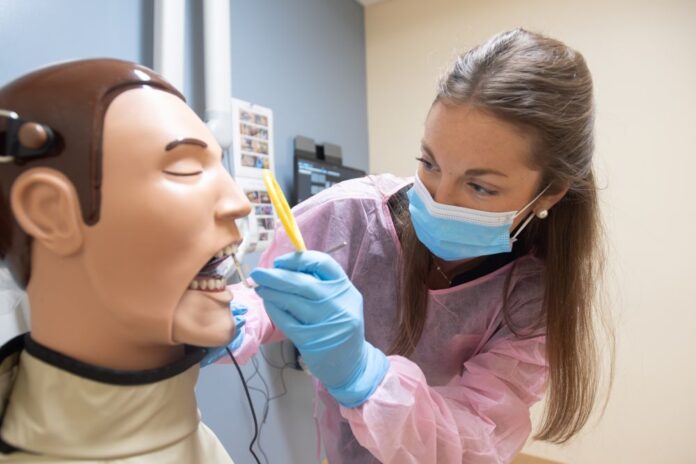
For anyone studying to be a dentist, taking a perfect X-ray takes a lot of practice. Normally, students have to wait for a faculty member to walk over and manually grade their work, a process that can slow things down when a lab is packed.
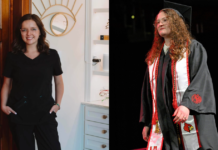
This is where University of Louisville School of Dentistry students like third-year learner Katie Hayden are stepping in – and stepping up to teach artificial intelligence (AI) to accelerate learning. For her second consecutive summer, Hayden paired up with her mentor, professor Gustavo Santaella, to work on an innovative project that uses machine learning to grade dental X-rays instantly.
How is UofL training future dentists?
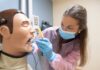
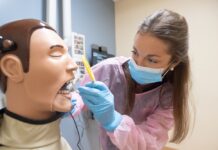
During this past summer, about 120 dental students practiced taking X-rays on a specialized mannequin before they ever take images of real patients in the fall. Katie’s job this summer was to sort thousands of practice X-rays into three buckets: ideal images, images with minor errors that are still usable, and images with critical errors that mean the student needs to try again.
By sorting these images, Katie is teaching an AI program to have the same sharp eye as UofL’s expert dental faculty. The long-term goal? A smartphone app that gives students instant feedback.
“The app will allow students to take a quick picture of the screen after taking an X-ray and learn quickly where they need to improve,” Hayden said. This eliminates the waiting game, letting students learn at a much faster pace while helping build confidence before stepping into a real clinic.
Bringing science fiction into the clinic
This summer project is just one example where the dental school is blazing the trail with Cardinal Intelligence to help revolutionize the standards of professional dental care. This forward-thinking approach leverages AI to advance research, empower students and transform community care.
While students are using AI to sharpen their skills in the lab, UofL faculty and residents are using it to tackle some of the most difficult patient cases in the clinic. According to associate professor David Donatelli, the momentum behind dental AI is “growing like a snowball rolling down a hill.”
UofL residents are currently doing field research on how AI can help plan, design and create complex dental restorations. They are even using it to instantly read and summarize massive amounts of dental literature, helping doctors quickly figure out the best evidence-based treatment plans for their patients.
Where this technology truly shines though, said Donatelli, is in complex cases involving facial trauma, cancer reconstructions or hereditary jaw disorders. In the past, dentists had to spend hours sculpting models by hand to map out a surgery. Now, AI does the heavy lifting, making the entire process more predictable.
By merging 3D facial scans with digital scans of a patient’s teeth, UofL doctors can create a literal “digital twin” of a patient on a computer screen.
“We actually have a computer-generated patient,” Donatelli explains.
This allows doctors to completely run through a virtual surgery, making any needed adjustments before the patient ever enters the operating room.
Cardinal Intelligence = human impact
At its core, UofL’s embrace of Cardinal Intelligence is focused on maximizing the human element.
“AI is not replacing the dentist,” Donatelli emphasizes. “There’s always somebody behind the scenes, a human being making it work.”
These high-tech efficiencies mean critical time savings for the university’s dental clinics. And, because these procedures take less time to complete, the UofL School of Dentistry can pass those savings directly on to the community, making high-quality dental care more affordable and accessible for everyone.
For dental student Katie Hayden, she sees AI as a complement to the provider’s role.
“Whatever we can do to provide the best care and also provide the best timeline for the patient, as well, is great,” she said. “At the end of the day, what we want is the best outcome for our patients. That’s why we’re here.”