




















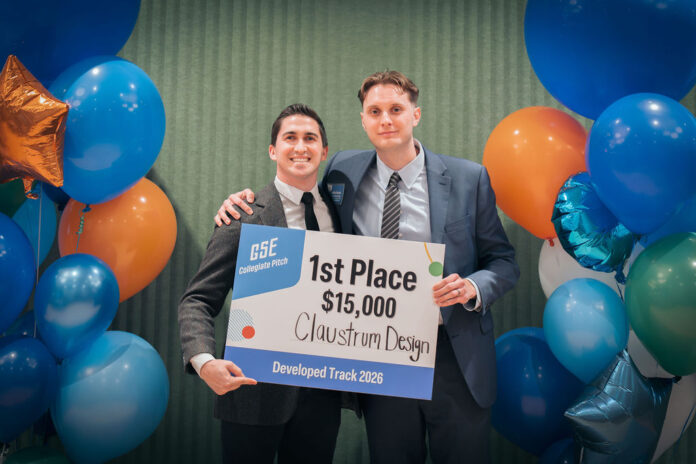
The University of Louisville continually redefines student success, both in and out of the classroom, and UofL School of Medicine students Justin Houts and Kieran Richards are living proof of this. Houts and Richards recently won the “developed” category in the Kentucky Intercollegiate Pitch competition, the state’s largest competition for student entrepreneurs. The win included a $15,000 award for their entry “Claustrum Design,” which aims to elevate medical practices with modern medical devices, moving away from outdated methods.
Houts and Richards shared their experiences with UofL News.
UofL News: You are both non-traditional medical students. How has your journey into medicine been different from the “typical” path? How has UofL shaped this path?
Houts: When I finished high school, I accepted an ROTC scholarship to attend Fresno State, where I studied biochemistry and found a passion for science. Several years into active duty, I realized that wasn’t where I saw myself in 20 years, so I started looking around at other opportunities. A friend made a connection with a surgeon on base, and she let me shadow her in the OR. I was enamored with the idea that someone could go under anesthesia with a terminal disease and wake up healthy and cured. The University of Louisville has provided a place for me to grow and pursue my passions freely while earning my medical degree. I’m especially grateful to all the great mentors I’ve had and connections I’ve made here who have supported my ideas.
Richards: I knew early on that I wanted to work in medicine. After high school, I chose to take a break before beginning college and serve an ecclesiastical mission in Argentina. I spent two years there, away from family, friends and academics, and focused on the importance of serving other people. This time provided me with the opportunity to see others as they are and to truly understand their genuine needs. I quickly realized the importance of human connection and the selflessness that is needed to care for others compassionately. Upon my return from Argentina, I refocused my attention on becoming a physician and applying those deep-rooted lessons to that goal. While here at ULSOM, I have had the privilege to work alongside amazing people and bright minds who have supported my goals and aspirations to not only become a doctor, but an entrepreneur and innovator in the field of medicine. This trailblazing school offers countless opportunities to network with renowned physicians and inventors, all of whom are so willing to provide meaningful advice and assistance in my work.
UofL News: At what point did each of you realize you wanted to go beyond practicing medicine and actually innovate within it?
Houts: A majority of medical school is a game of mass memorization. This makes sense, given the vast advances that have taken place over the last 100 years. But spending a day memorizing facts doesn’t fuel my drive. I love to create. When I first met my now wife, I told her it was my goal in life to play and write rock music. I got my MBA from Berklee College of Music because I wanted to be able to market myself as a songwriter and artist. Eventually, I realized I preferred music as a passion instead of a job, but that same desire to create and build something from scratch never went away. I love looking at a problem and trying to discover a new solution. There have been so many evenings I’ve started working on a project or idea, and before I know it, I look at the clock and it’s 11 pm, and I haven’t had dinner. Nothing I’ve built has been a sacrifice; it’s all been a labor of love.
Richards: With my beginnings in rural medicine, I had many opportunities to create, reexamine and iterate new policies and workflows for the small medical staff to improve the care we offered to our underserved patients. The changes I implemented started with simple modifications, such as how we organized our office and how we performed basic patient intake skills, and eventually they led to how we improved our in-office procedures and patient care outcomes. These everyday changes helped me see the impact of innovation on a small rural healthcare ecosystem, and it evolved as I started my education at the School of Medicine. Here, I have been able to see the broader impact of medicine and the everyday processes and tools that we utilize to impact patients. As seen by Dave Brailsford’s British cycling team, making improvements in minor ways can create a revolutionary outcome, and I believe that applying that process to medicine will dramatically improve our healthcare system to what patients deserve.
UofL News: Can you walk me through one of the devices you’ve developed and the impact it could have on patient care?
Both: Our most developed product is called Precisionject… a novel device that attaches to an existing syringe to modify the user’s grip so that they can hold a syringe like a pencil for improved placement accuracy, stability and control. Precisionject attaches to the syringe plunger and controls it with a modulator near the needle-end of the syringe so that the user does not need to move their hand to inject or pull out fluids while performing procedures under ultrasound guidance. The current approach to highly precise injection procedures requires one hand to hold the syringe and push down on the syringe’s plunger to eject the solution. This leads to inaccurate placement, injured tissues, failed procedures, and poor patient satisfaction. By utilizing Precisionject to hold the syringe like a pencil, it allows the user to take advantage of a familiar grip to improve needle placement and decrease tissue damage. Our goal is to empower physicians and elevate the standard of patient care.
UofL News: For someone outside the medical field, how would you describe Claustrum Design in simple terms?
Both: We create new medical and surgical devices to improve patient outcomes and help physicians perform at their highest level. For some of our devices, this may look like lowering a post-operative complication rate; for other projects, it might be improving a logistical process that happens in the hospital basement that no patient will directly encounter. At the heart of everything we do, you will find the patient. Every product we make is aimed towards improving their health and hospital experience from the moment they walk in the door until they return home to their family.
UofL News: How has your experience at the University of Louisville contributed to the way you pursue something like this?
Richards: The University of Louisville has one of the most community-minded and supportive environments for students to thrive and grow. As we have begun this journey, we have encountered countless people who believe in us and want us to succeed. From our phenomenal team at Tech Transfer to the physicians at UofL Health who have provided meaningful feedback, to our fellow students who inspire us, I don’t think it’s possible to find a more supportive atmosphere for students to grow.
UofL News: What would you advise a prospective medical student who wants to follow your steps?
Houts: I’ve always lived by the motto that I’d rather live with failure than regret. I’ve probably had 100 ideas for medical devices since starting school, and 96 of them didn’t turn out well. I used to shy away from this reality because I thought it meant I was a failure if my idea didn’t succeed. I’ve since come to realize that none of that really matters, and the worst thing I can do is not try or give up on my ideas for fear of failure. I would tell anyone else who has an idea in their field to go for it. The failure isn’t as embarrassing as you think it’ll be, and the prospective rewards that await are priceless. Chase your ideas- the journey they’ll take you on is the adventure of a lifetime.
Richards: First, I can’t stress the importance enough of surrounding yourself with great people. I am fortunate enough to have amazing mentors, friends and family, and Justin is no exception. Justin has been a great partner to work with, and we have created a deep friendship throughout this work. Seek out the people who believe in you and always find ways to support others. Second, great innovators are always looking to improve the world around them. Take the time to identify the problems around you and be patient with yourself as you imagine what could fix that problem. Finally, stick with it and be relentlessly engaged in your goals.
UofL News: What’s the next step for your invention?
Houts: We are going to keep pursuing these projects we have started and see where they take us. We will have the first working prototype of Precisionject built soon and will start in vitro trials to get as much quantitative data as possible to support our continued grant applications and funding opportunities. Maybe if we’re lucky, we’ll even be able to drum up some interest from investors soon. We’ve been accepted to attend a business conference in Salt Lake City in June, so we will present our company there and see what connections we can make. We’ve recently partnered with Dr. Redi Rahmani, the director of cerebrovascular neurosurgery at Jewish Hospital, on a project that looks to improve the logistical operations behind OR turnover. Safe to say, you can probably find us in the library studying, in my garage 3D printing and sketching, or at our laptops at 10 p.m. on a Friday writing grant applications. And on the rare occasion, we get the privilege of talking with other people to share our vision and goals for the future.