
























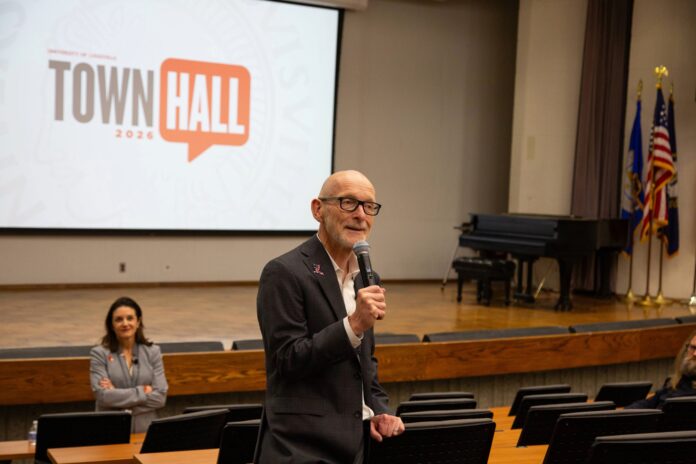
President Gerry Bradley opened the Nov. 19 President and Provost Town Hall on the Health Sciences Center campus by addressing how federal and state actions have reshaped UofL scholarships.
“This has been a divisive time in our country and in politics, and certainly the last thing we want is to bring that divisiveness and division to our campus. We have been doing and will do what we can to support every single student in their journey and every faculty member and our staff,” Bradley said.
In a recent message to campus, Bradley laid out how the changes, which began in 2023, have continued in response to numerous changes to the federal and state legal landscape.
“We are driven to do the right thing and do what we had to do [in response to changing laws],” Bradley said.
Campus safety and parking
Several questions, both in-person and pre-submitted, asked about campus safety procedures and policies.
Gov. Andy Beshear called on Kentucky universities to review their sexual assault policies, and pre-submitted questions asked how UofL handles such cases. Bradley pointed to ongoing training, newly filled police positions, cameras with good visibility across campus and the PEACC Center’s educational programs, including Green Dot. The university has also hired additional Title IX investigators.
HSC employees raised the issue of parking, especially after dark. Leaders acknowledged the problem and said a few options are in place, including escort services by the UofL Police Department. Employees with valid permits can move their cars into reserved parking areas after 5 p.m. Opening those areas earlier would be difficult, leaders said, because many reserved permit holders are still working or traveling between campuses at that time.
Support for pre-health students
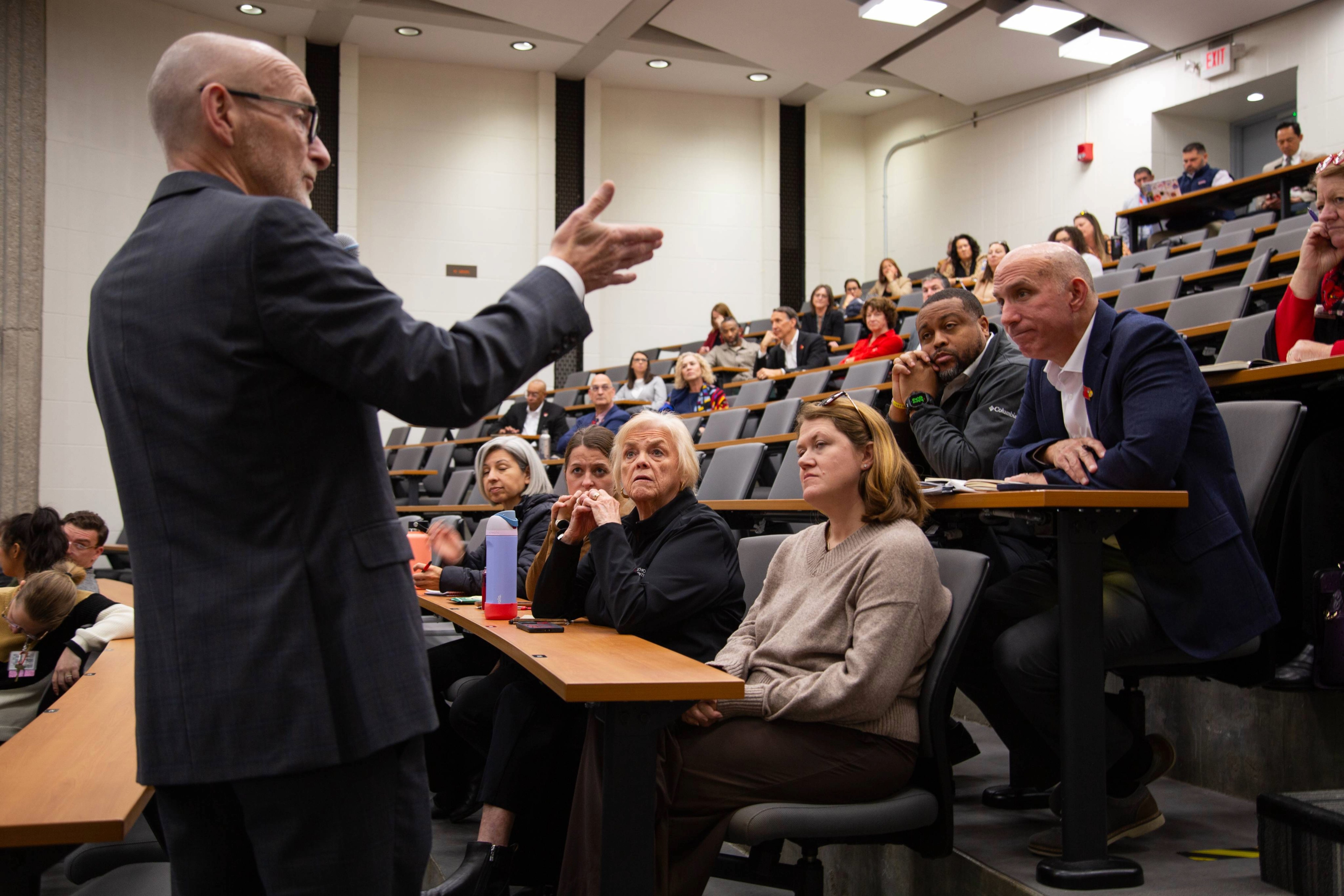
An audience member suggested a task force to help pre-med and pre-health students prepare strong applications, noting that some advisors may not know how to guide them.
Jeffrey Bumpous, executive vice president for health affairs and dean of the School of Medicine, pointed to an existing pathways program that offers ACT prep and math preparation in high schools, with plans to extend it to rural counties beyond Jefferson County. UofL is also launching a health profession living-learning community, designed to include commuter students, to help with MCAT preparation and shadowing.
“We are passionate about this,” Bumpous said.
Cardarelli added that the university is working on a stronger academic policy to keep students from lingering in a major where they may not succeed.
“We want all of our students to be successful, and the earlier we can direct them into a path where they can be successful, the better,” she said.
Additional items addressed included:
- Student investments: Cardarelli outlined substantial investments. The university has hired more academic advisors and student success coaches, launched an Office of Scholarships and started a financial literacy program. It is also putting more money into registered student organizations (RSOs) and living learning communities. Thirty-eight percent of UofL students are first-generation and 44% are Pell-eligible. Unmet financial need is the top barrier to student success at UofL, Cardarelli said.
- Winter break: Since then-President Neeli Bendapudi added time off in winter 2018, the university’s commitment has been two weeks, Bradley said. Some years have included slightly more time off, depending on how the holidays fall against the academic calendar. This year’s break is two weeks long.
- Performance evaluation training: Darrell Clark, vice president of Human Resources, said conversations are underway about requiring faculty training on the new evaluations. HR is working with Faculty Affairs and the Office of the Provost to put a requirement in place for staff. The biggest concern, he said, is making sure faculty who manage staff know how to apply the new rating scale.
- Measuring return on investment: Asked how the university measures the impact of summer programs and other outreach to middle and high school students, Cardarelli said she has challenged her team to evaluate overall student success initiatives and recruitment programs. A large part of the equation, though, is a sense of belonging. RSOs, for instance, can offer programming the university cannot, which helps build community, she said.
Share feedback
Members of the UofL community can share feedback about the Nov. 19 Town Hall through the follow-up form available until Nov. 26 at 12:15p.m.