

























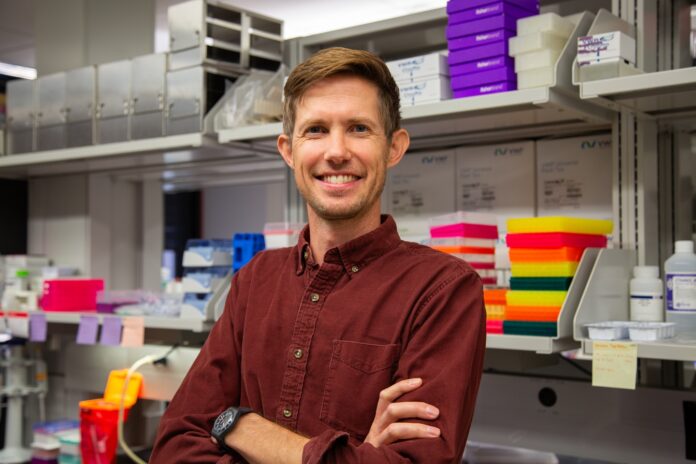
When University of Louisville researcher Corey Watson was mulling over the vast decision of where to begin his career after college or even what to research, a book titled “The Selfish Gene” by Richard Dawkins sparked his interest. The book personifies a gene’s desire to survive, adapt and evolve into future generations. With the studied expertise and the discerning eyes of a librarian, geneticists identify and categorize genes much like organizing books chronologically in a collection. Genomes stand in for large textbooks, genes as their chapters, each building the massive history of humanity’s short but genetically diverse life on Earth. This puzzle intrigued Watson and led to his first job working in a genetics lab at UofL before carrying on his education.
Watson, who works in the Department of Biochemistry and Molecular Genetics, School of Medicine, focuses on comparative genomics and immunology, also known as immunogenomics. This expertise earned the Watson Lab a place on a multidisciplinary team led by Penn State, Washington University and the National Human Genome Research Institute who recently generated the first complete genomes of six ape species: chimpanzee, bonobo, gorilla, Bornean orangutan, Sumatran orangutan and siamang. Watson, and members of his lab team assisted in undertaking the large project, utilizing their niche expertise to help identify and analyze the ape genes related to immunity.
The ape genome findings published in Nature help scientists better understand species-specific genes that may have played a role in the species’ survival and development. Geneticists like Watson are discovering the narrative of evolution by studying and translating genomes into actionable information. Genomic differences between humans and our close genetic relatives may direct future advancements in understanding human health and clinical research.
“I like to think that when you understand more about the biology of these regions, you understand more about how they can be useful to humans in the health setting,” Watson said.
Piecing together the ape genome puzzle
The complete sequencing of the six ape genomes revealed novel genes and variants related to diet, immunity and cellular activity.
“The regions that harbor antibody genes are very complex parts of the genome, and we still actually don’t understand them that well, even in humans,” Watson said. “We don’t know much about their evolutionary histories. While we now understand they are places in our genome that have very particular characteristics, we lack a clear understanding of how quickly they can diversify and take on new functions within and between species.”
The complete genomes of the six ape species have been sequenced thanks to technological advancements that have made genomic sequencing cheaper and more efficient. However, the process for sequencing a genome is not as simple as running it through a single computer program, as seen in sci-fi movies like “Jurassic Park.” Watson describes the sequencing process as similar to completing a jigsaw puzzle. Laboratory researchers break up chromosomes into small pieces of DNA, analyze them and put them back together to understand the whole.
“We’re now to the point where — with a lot of effort through the input of a lot of people — we can fully reconstruct genomes, and it doesn’t cost you a billion dollars to do it,” Watson said, referring to the rough cost of the original Human Genome Project of the early 2000’s.
Technological developments have allowed today’s researchers to analyze much larger DNA pieces, so the change in sequencing difficulty is like having fewer pieces of a puzzle to put together.
Despite the progress, this work remains an intense process requiring experts like Watson, who helped identify and describe the ape genes that contribute to immune responses. For the Watson Lab and other immunogenomic researchers, future advancement in our genetic understanding of immunity will require sequencing of many more individual apes and humans to better identify gene variations across these species.
Students are critical to the research
Watson and his team were just one branch of a large team of scientists piecing together and organizing the jigsaw of the six ape genomes. The amount of work needed in genetics to sequence, annotate and store genetic information is great, which leaves space for rising biology students.
“Students are critical to our research enterprise. All of us were once students; it’s where you start,” Watson said, regarding the future of genetic studies. “The future of the system we have built in this country wholly depends on our ability to continue to recruit and effectively train students who are interested in scientific research.”
For Watson and his team of UofL researchers, the work to understand the genetic story of humans’ adaptive immune system continues with more of our close relatives. The Watson Lab recently completed annotations of antibody genes in Rhesus macaques. The study included a curated public database of more than 1,000 previously unidentified alleles and is available with the team’s January 2026 article published in Immunity.